

Key Takeaways: The best knee brace for snowboarding depends entirely on what’s going on with your knee. Compression sleeves handle warmth and general achiness. Patellar straps target kneecap tendon pain, hinged braces support knees with MCL history or side-to-side instability. Functional or custom braces are for riding with an ACL injury, after a reconstruction, or with ongoing rotational instability. Fit matters more than brand or price, and no brace replaces the strength and conditioning that actually reduce injury risk. If your knee gives out, swells repeatedly, or you’ve never had it assessed, get it looked at before buying a brace.
If you’ve searched for the best knee braces for snowboarding, you’ve probably landed on a dozen articles that are really just ranked product lists. Most of them never answer the question that actually matters, which is which type of brace fits what’s going on with your knee.
A brace that’s perfect for someone coming back from an ACL reconstruction is overkill for someone whose knees just ache after a long day on the mountain. And a brace that’s great for general warmth and comfort won’t do much at all for a knee that feels unstable.
In this article I’m going to break down the actual categories of knee braces, what each one does and doesn’t do, and how to figure out which one makes sense for your situation so you’re not guessing your way through a checkout page.
Heads up: I may earn a small commission if you buy through the links in this post. Don’t worry, it doesn’t cost you anything extra and it helps me keep creating helpful content.
Do You Actually Need a Knee Brace for Snowboarding?
For a lot of riders, the honest answer is no. If your knees feel good, you have no injury history, and nothing is bothering you on the mountain, a brace isn’t going to make you a better or safer snowboarder.
Where a brace genuinely earns its place is when there’s something specific to support: an old ligament injury that leaves your knee feeling unstable, a knee that gets achy and swollen over long days, or a return to riding after a significant injury or surgery.
The reason this matters is that a brace is a tool for managing a specific problem, not a substitute for a knee that’s prepared for the demands of the sport. Strength, mobility, and conditioning are what actually reduce your risk on the mountain. A brace can support you while you build those things, but it can’t replace them.
Are you a skier or snowboarder looking for a program that will help get you ready to perform on the mountain this season?
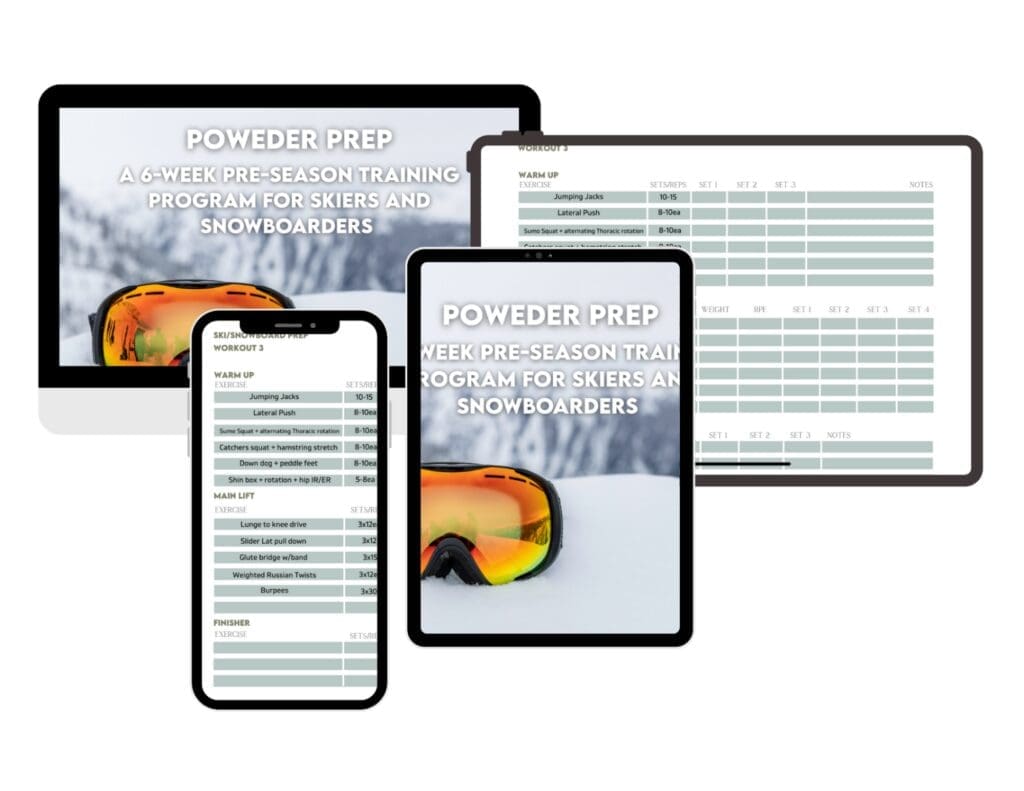
That’s exactly why I created Powder Prep. This program was designed by two Doctors of Physical Therapy who are winter sport athletes themselves, to help you feel stronger and more confident on the mountain this season.
Over 6 weeks you’ll build the endurance, strength, balance, stability, and power needed for long days on the mountain, so you can reduce the risk of nagging aches and old injuries resurfacing.
Types of Knee Braces for Snowboarding
There are four main categories, and they’re built to do very different jobs. This is the part most product roundups skip entirely.
Compression sleeves: these are the simple pull-on neoprene or knit sleeves. They provide warmth, mild swelling control, and proprioceptive feedback, which is a fancy way of saying they help your brain know where your knee is in space. What they don’t provide is any real mechanical stability. If your knee is structurally fine but gets stiff, achy, or cold on long days, this is usually the right category. It’s also the lowest profile option under snow pants. If that sounds like what you’re after, here’s the compression sleeve I recommend.
Patellar straps and wraparound braces: these apply targeted pressure at or just below the kneecap. They’re built for patellar tendon pain specifically, that sharp or achy spot right below the kneecap that flares up with jumping and repeated loading. They’re a very specific tool for a very specific type of knee pain. If your pain isn’t coming from the patellar tendon, a strap isn’t going to do much. If it is, here’s the patellar strap I recommend.
Hinged braces: these have rigid or semi-rigid supports running along the inside and outside of the knee with a mechanical hinge at the joint line. They actually resist side-to-side stress, which makes them the go-to for anyone with MCL history or a knee that feels like it wants to buckle inward. For a lot of snowboarders with a previous MCL sprain, this is the sweet spot. They’re bulkier under snow pants than a sleeve, but most people adjust to it quickly. I recommend two options here depending on how much support you need: the DonJoy Performance Hinged Knit Knee for moderate support, or the Bionic Knee Brace for maximum support.
Functional or custom ligament braces: these provide the most support of any category, designed to resist both rotation and forward shifting of the shin bone. This is the category for someone riding with an ACL injury, returning after a reconstruction, or dealing with ongoing instability from a previous ligament injury. They’re significantly more expensive and are typically fitted through a clinic or bracing vendor rather than ordered online, because fit is doing a lot of the work here.
How to Choose the Right Knee Brace for Your Situation
Rather than starting with brands, start with what’s actually going on with your knee:
- No injury history, knees just get achy or cold on long days: a compression sleeve is almost always enough
- Pain right below your kneecap that flares with jumps and landings: a patellar strap can help with symptoms, but it’s worth figuring out why the tendon is irritated in the first place
- Old MCL sprain, or a knee that feels unstable side to side: a hinged brace is the category you want
- Riding with an ACL injury, after a reconstruction, or with ongoing rotational instability: a functional brace, fitted through your surgeon or physical therapist rather than guessed at online
- Your knee is giving out or catching and you don’t know why: don’t buy a brace yet, get it assessed first
That last one matters more than the rest. A brace can mask instability well enough to get you down the mountain, and that’s exactly what makes it risky when you don’t yet know what’s causing it.
A Few Things That Matter More Than the Brand of Knee Brace for Snowboarding
Fit beats price every time. A well-fitted mid-range brace will outperform a poorly-fitted premium one. Most braces are sized by thigh circumference, not by shoe size or general build, so actually measure rather than guessing between small and medium.
Migration is the number one complaint. Braces slide down over a long day of riding, especially as you warm up and sweat. Look for silicone grip strips along the inside of the thigh cuff, and expect to re-tension the straps once or twice during the day.
Cold changes how materials behave. Neoprene stiffens up in the cold, so a brace that feels perfect in your living room can feel noticeably tighter on a below-freezing morning. Try it on with your actual base layers before you commit to a full day in it.
What the Best Knee Brace for Snowboarding Won’t Do
This is the part the product roundups tend to leave out.
A brace will not prevent a serious ligament injury in a high-energy fall. The forces involved in catching an edge at speed or landing a jump badly are well beyond what any off-the-shelf brace is designed to absorb. The research on braces preventing first-time injuries in healthy knees is mixed. Which is worth knowing before you spend a few hundred dollars expecting protection you’re not actually getting.
A brace also won’t build the strength, control, and endurance your knees need for long days on the mountain. Most knee injuries from snowboarding happen when fatigue sets in and your mechanics start to fall apart late in the day. And a brace won’t fix that. But being properly prepared can.
Something else that’s important to mention is the false sense of confidence we sometimes get when wearing a brace. We feel like we can ride terrain we usually wouldn’t or attempt a trick we would otherwise pass on without doing the underlying work the knee actually would benefit from long term. The goal is to use it as support while you address what’s actually going on, not as permission to skip that work.
For more on how these injuries actually happen and what tends to be behind them, I broke that down in detail in knee injuries from snowboarding.
When to Get Your Knee Looked At Instead
A brace is a reasonable thing to try for general achiness or a knee you already understand. Here’s when buying one shouldn’t be your first move:
- Your knee gives out, catches, or locks up
- You felt or heard a pop when the pain started
- There’s swelling that keeps coming back after every day on the mountain
- You can’t fully straighten or fully bend the knee without pain
- The pain is getting worse over the season rather than better
- You’re trying to figure out which brace to buy because your knee feels unstable and you’ve never had it assessed
Any of these means the brace would be covering up a question that hasn’t been answered yet. Getting a real assessment first tells you whether you need a brace at all, and if you do, which one.
How Rise Performance and Physical Therapy in Denver, CO Can Help
At Rise Performance and Physical Therapy in Denver, Colorado, we work with snowboarders and skiers who want to ride hard all season without their knees becoming the limiting factor. That means figuring out what’s actually driving your symptoms, telling you honestly whether a brace is part of the answer, and building the strength and control that reduce your risk in the first place.
We look at how your knees, hips, and ankles are working together, test your strength and stability through the positions that matter for riding, and build a plan around your actual season and goals.
Want to know whether you need a brace or something else entirely? Request an Appointment, available in person in Denver or Wheat Ridge, or virtually through Virtual Rehab Coaching if you’re not local.
Next on Your Reading List

