

Key Takeaways: Dry needling in Denver for pain relief uses a thin monofilament needle to release tight, guarded muscle tissue, and it can create real pain relief quickly, often within the very first session. What it does not do is change the reason that tissue got overloaded in the first place. The most reliable, longest-lasting results come from pairing dry needling with strength and capacity work that keeps the change in place.
If you have been searching for dry needling in Denver for pain relief, you are probably somewhere in the middle of a frustrating stretch. Something keeps tightening up. Stretching helps for about twenty minutes. You have foam rolled the same spot so many times you could find it with your eyes closed. And now you are wondering whether dry needling will finally be the thing that works.
Here is my honest answer, as a Doctor of Physical Therapy who uses dry needling with patients every week.
It works. It works fast, sometimes faster than anything else I do in a session. But it also will not fix your problem for good by itself.
Both of those things are true at the same time, and almost nobody explains the second half. So let’s go through what dry needling actually does, who it genuinely helps, what happens in a session, and what has to happen afterward for the relief to stick.
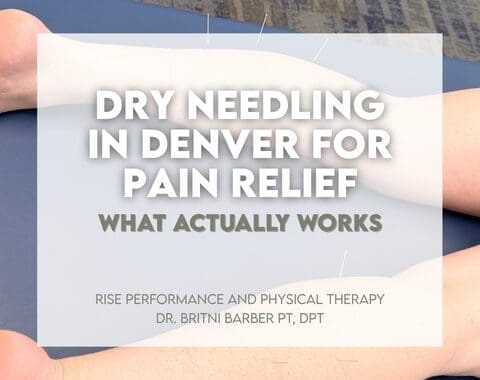
What dry needling actually is
Dry needling is a technique where a licensed provider inserts a very thin monofilament needle into a tight, irritable band of muscle tissue. The needle is solid, not hollow. Nothing gets injected, which is exactly where the word “dry” comes from.
The target is usually a trigger point, meaning a spot in the muscle that has become overactive and stayed that way. That spot is often tender when you press it, and it can sometimes refer pain to other areas of the body. For example, a trigger point in your glute can send symptoms down the back of your leg. Or one in your upper trap can show up as a headache behind your eye.
When the needle reaches the right spot, the muscle frequently produces a local twitch response, a quick involuntary contraction that releases in a second or two.
Dry needling vs Acupuncture: They are not the same
They use a similar tool but they come from completely different backgrounds.
Acupuncture comes out of Traditional Chinese Medicine and works from meridians, energy flow, and whole-body systems. Dry needling comes out of Western musculoskeletal anatomy and treats the issue at or around the area of pain. I am treating a specific muscle that is limiting a specific movement you are trying to get back or causing pain.
There is not a right versus wrong here. These two are built to solve different problems. People typically turn to acupuncture for whole-body concerns like stress, sleep, headaches, or digestion. Dry needling targets a specific muscle that is limiting a specific movement or driving a specific pain. That might be a calf that will not let your ankle bend far enough to hit depth in a squat, an upper trap that shuts down your overhead reach, or a glute that keeps referring pain down the back of your leg.
The tool is similar. The technique and the method behind each one are very different, and that shared tool is really the only thing the two have in common.
If you are struggling with a specific muscle that keeps limiting a movement you want back, dry needling is your solution.
How Dry Needling Helps with Pain Relief
A few things happen at once, that lead to a positive outcome.
The muscle actually lets go. That twitch response resets a muscle that has been holding tension it was never asked to hold. You often feel the difference before you get off the table.
Blood flow increases to a spot that was not getting much. Guarded, contracted tissue restricts its own circulation. The needle interrupts that pattern and brings fresh blood into an area that has been running on very little.
Your nervous system turns the volume down. This is the piece people underestimate. When an area has been irritable for a while, your nervous system starts treating that whole region as a threat and protects it aggressively. Dry needling gives that system new input, and the protective response often eases as a result.
So what does this mean for you? Range of motion improves, muscle guarding backs off and movements that felt sharp or restricted feel available again. For a lot of people, that window is the first time in months they can actually train without bracing against something.
Who Dry Needling Actually Helps
Dry needling is a great fit if any of this sounds familiar.
- A muscle that feels tight no matter how much you stretch it. Stretching a guarded muscle does not release it. It often just tugs on tissue that is already protecting itself for some deeper reason.
- Limited range of motion that has not budged. You cannot reach behind your back the way you used to, or your squat depth disappeared and never came back.
- The same spot flaring over and over. Same hip, same shoulder blade, same side of your neck, every time you ramp your training back up.
- Pain that shows up during a specific movement. Pinching at the bottom of a squat, a catch when you press overhead, something that grabs when you run downhill.
- You are mid-flare and need enough relief to start moving again. Sometimes you need the volume turned down before you can do anything productive. That is a completely legitimate reason to use dry needling.
There are also people I would not start here with.
If you have a genuine fear of needles, this is not worth putting yourself through the anxiety of a dry needling session. I have plenty of other tools and a stressed-out nervous system does not respond well anyway.
If you are on blood thinners, pregnant, or managing certain medical conditions, tell your practitioner up front so they can screen appropriately.
And if your issue is purely a capacity problem, meaning your tissue is not irritable or guarded but simply is not strong enough yet for what you are asking of it, then needling is not the missing piece. Instead, working on building strength in the muscle and surrounding areas with sports physical therapy would be a better solution.
What Dry Needling Can’t Do On It’s Own
This is the part I want you to leave with.
Dry needling changes the state of the tissue. It does not change the reason the tissue ended up in that state.
If your calf keeps locking up because your running volume climbed faster than your calf’s capacity to keep up, dry needling will absolutely calm the calf down. But it will not raise the capacity. Returning to the same mileage without addressing the underlying issue in the calf means things might flare back up again in a few weeks.
That is the whole mechanism behind something I see constantly. Which is people who have been getting dry needling every week for months or a year and describe it as “the only thing that helps.” It is helping. But it is just helping temporarily, because nothing in the plan is changing the underlying demand mismatch.
Dry needling opens the door by calming down symptoms and allowing the muscle tissue to be in a better position to make long-term change. However, pairing dry needling with intentional rehab and strength training is what allows you to actually walk through that door and overcome symptoms long-term.
What to Expect in a Dry Needling Session?
The first thing we always want to do is assess. I want to know what movement is limited and which tissues are actually driving it before anything gets needled, because needling a spot that hurts is not the same as needling the spot that matters.
The needling itself is quick. Most people describe the sensation as a deep ache or a cramping feeling rather than a sharp poke, and the twitch response feels like a fast, involuntary contraction in the muscle. It is over in a second. Some areas are more sensitive than others, and I will tell you which ones before we get there.
Afterward, you may expect to experience some soreness. It usually feels like the day after a hard training session, localized to the area we worked on, and it typically settles within 24 to 48 hours. Light movement helps, but sitting still and avoiding movement altogether likely won’t be helpful.
If you are just doing dry needling your session will end here, but if you are incorporating dry needling into your regular physical therapy sessions then we’ll get moving. You’ll want to use the window immediately, so we go straight into range of motion work and loading while the tissue is more available.
I wrote a full breakdown of what to do in the days after your appointment here: What to Do After Dry Needling: Recovery and Next Steps
How many sessions will you need of dry needling in Denver for pain relief?
You’ll probably need fewer dry needling sessions than you think.
You can see results immediately. This isn’t something that takes 6 weeks of appointments to see results, that’s the good news. Many people notice a real change in the same session, before they even leave, and most of the rest feel it by the next day.
How many sessions you’ll need in total depends on several things:
- How intense your symptoms are right now. A dull nagging ache and a sharp pain that doesn’t allow you to move are different starting points.
- How flared up you currently are. An area in an active flare usually needs a couple of visits to settle before it holds for longer.
- How long you have had the pain. Something that showed up three weeks ago tends to respond faster than something you have been managing for several months or a year.
- How much of the problem is guarding versus capacity. Guarding responds quickly to needling. Capacity responds to training, and that timeline is measured in weeks of consistent loading. In this case, pairing traditional physical therapy with dry needling is your best solution.
- What you do between sessions. This is the biggest variable and the one you control.
For most people I see, we are talking about a handful of sessions layered into an actual plan, not an open-ended standing appointment.
Why Dry Needling Works Best When Paired with Strength Work?
Everything I do runs through the same four phases, and dry needling has a specific home inside them.
Root Cause Discovery. We figure out why this tissue is the one taking the hit. That is usually a story about what is not sharing the load, not about the sore spot itself.
Foundation Rebuild. This is where needling earns its spot in the plan. It buys you range of motion and a calmer nervous system, and we spend that immediately on rebuilding the positions and patterns you lost.
Capacity Expansion. Now we load. Progressively, on purpose, until your tissue can handle what your actual life asks of it. This is the phase that makes the relief permanent, and no amount of dry needling sessions can do this for you.
Longevity Lock-In. We build the version of your training that keeps this from cycling back, so you are not managing the same flare every season.
You are not fragile and you are not broken. In almost every case I see, the issue is that your body was underprepared for the demand you handed it. Needling makes you comfortable enough to start closing that gap. Training is what closes it.
What to Look for When Searching for Dry Needling Services in Denver?
Plenty of clinics around Denver offer this. Not all of them offer it inside a plan. This is when dry needling in Denver for pain relief can make a lasting impact. A few things worth checking before you book:
- Do they assess you before they needle you? If someone reaches for dry needling before watching you move, they’re not tailoring the care specifically towards your needs.
- Are they licensed and specifically trained in dry needling? Any time you get a service like this done, you want to know a licensed, specifically trained professional is the one doing it.
- Do you leave with something to do? A good session sends you home with movement, loading, and a reason for why you’re performing each.
- Is there an actual endpoint? A plan should have a direction and a finish line. An indefinite weekly standing appointment with no progression is a subscription, not a plan.
- Do they treat needling as one tool or as the whole treatment? You already know which answer you want.
This article is general education and not individual medical advice. If you are dealing with pain that is worsening, following an injury, or coming with symptoms like numbness, weakness, or changes in bowel or bladder function, get evaluated in person.
Where Can you Find Dry Needling in Denver for Pain Relief ?
If you are in Denver and you want dry needling that comes attached to a real plan instead of a standing appointment, that is exactly how I work. We find the root cause, use needling to open up the window, and then build the strength and capacity that keeps you out of the flare cycle for good.
I see patients in person at two locations:
- 44 West Louisiana Ave, Denver, CO 80223
- 5455 West 38th Ave, Wheat Ridge, CO 80212
Come in, get assessed, and leave with an actual answer about what is driving this and what it will take to fix it.

