

Key Takeaways: Snowboarding requires you to have good control on your board, be able to control and move in rotation, and the ability to absorb impact for a full day. The strength training that actually helps support these goals builds lateral stability, rotational power, explosive strength, and strong knees, hips, and a low back. A focused 4 to 6 week strength training program before the season, not just cardio, is what prepares your body for the mountain.
What Type of Strength Training Exercises for Snowboarding Are Best?
If your off-season prep for snowboard season only consists of cardio, you’re missing a big piece that actually protects your body on the mountain during the season. The best strength exercises for snowboarding don’t look like a typical gym routine. Snowboarding requires you to control turns on your edges, twist through your spine, and absorb impact over and over again, for hours at a time. And often on legs that are already fatigued by lunch.
That’s a different kind of demand than running or lifting alone prepares you for. This post breaks down the four types of strength training that actually carry over to a day on the mountain. In the post we’ll cover lateral movements, rotational power, explosive strength, and the joint-specific strength that keeps your knees, hips, and back holding up during long days on the mountain. Whether you’re riding a couple times a season or every weekend this winter, these movements will help you build a solid foundation before the season starts.
Lateral strength for edge control
Every turn you make on a snowboard starts with loading an edge which requires lateral movement patterns. A lot of gym routines skip these types of movements entirely. Building strength and control side to side is one of the most direct carryovers to actual riding.
Work these lateral strength training movements into your training:
Lateral lunge to high knee: Squat into one leg while keeping the other extended. At the bottom of the movement drive working leg into the ground to stand up and end in a high knee position. Can make this more challenging by adding a dumbbell in the opposite hand as the working leg.
Lateral Banded Step Outs: Place a mini looped band around your ankles. With most of your weight on the stance leg the opposite leg is going to quickly tap diagonally out to the side.
Perform two or three sets of these, twice a week, to help build side-to-side stability that can help with smoother, more controlled turns.
Rotational power
Carving during turns, doing tricks, or even hitting an unexpected bump on the trail can all require your core and hips to produce and control rotation. This is also where a lot of riders are underprepared.
A few exercises that build real rotational power:
Loaded Reactive Lateral Bounding: Holding a small plate perform a lateral bound or jump from one leg to the other. As you land on your opposite leg perform a torso rotation into the landing side.
Power Pallof Press with Rotation: Set up a band at about chest height. With a stance slightly wider than hip width apart and two hands on the band rotate through to the opposite side quickly using some power behind your rotation.
Rotational strength doesn’t just make your carves feel more powerful. It’s often the difference between absorbing a rough landing cleanly and feeling it in your low back the next day.
Plyometric Exercises
Even though snowboarding usually requires several hours or all day on the mountain, it also requires you to be able to react in a moment’s notice. Because of this it’s important to be able to quickly absorb force, or adjust
Plyometric and power work can be helpful to work on for this exact reason:
Double Leg to Single Leg Forward Bounds: Start on two legs, jump off two legs and land on one leg. Try to stick the land for a second before returning to the starting position
Seated Power Jumps: Start sitting on a bench or plyo box. Use arms and lift legs to gain momentum. Swing arms and legs down, jump off feet while swinging arms back into the air to help propel you forward.
Start with lower volume here. Two to three sets of five to eight reps is plenty. The goal is quality of movement and speed, not fatigue.
Building Knee, Hip and Back Strength
Your knees, hips, and low back take on the most repetitive load of any joints while snowboarding, which is exactly why they’re usually the first thing to feel it the next morning.
But building real strength and capacity here can help your body handle longer days on the mountains with less soreness and fatigue the next day.
Here are a few staple movements worth trying:
Dumbbell Reverse Lunge to High Knee: Start with a dumbbell in one hand. Step back with the opposite leg into a reverse lunge. Use the front leg to drive through the floor and stand tall as the opposite leg comes into a high knee position.
Kickstand RDL with Hip Internal Rotation: Start in a kickstand position with a dumbbell in the opposite hand as the front leg. Hinge through the hips to perform a Romanian deadlift while slightly rotating towards the pinky toe of your stance leg. Return back to the top and repeat.
Strength training requires consistency over time. But working on building true strength is what will allow you to ride a full day and still feel good walking down the stairs the next morning.
Putting it all together
Two to three focused strength sessions a week, built around these four categories, lateral movements, rotation, plyometrics, and joint-specific strength, is enough to make a real difference on the mountain if you start it four to six weeks before your first day riding.
If you don’t have that much time before your season starts that’s okay! Doing something is always going to be better than doing nothing.
A common question I get is: Can you or should you continue to do these exercises once the season starts and the answer is yes.
You may drop down to one or two training days per week depending on how often you are riding. But continuing to keep your muscles strong during the season will not only make you a better rider but also reduce your risk of injury.
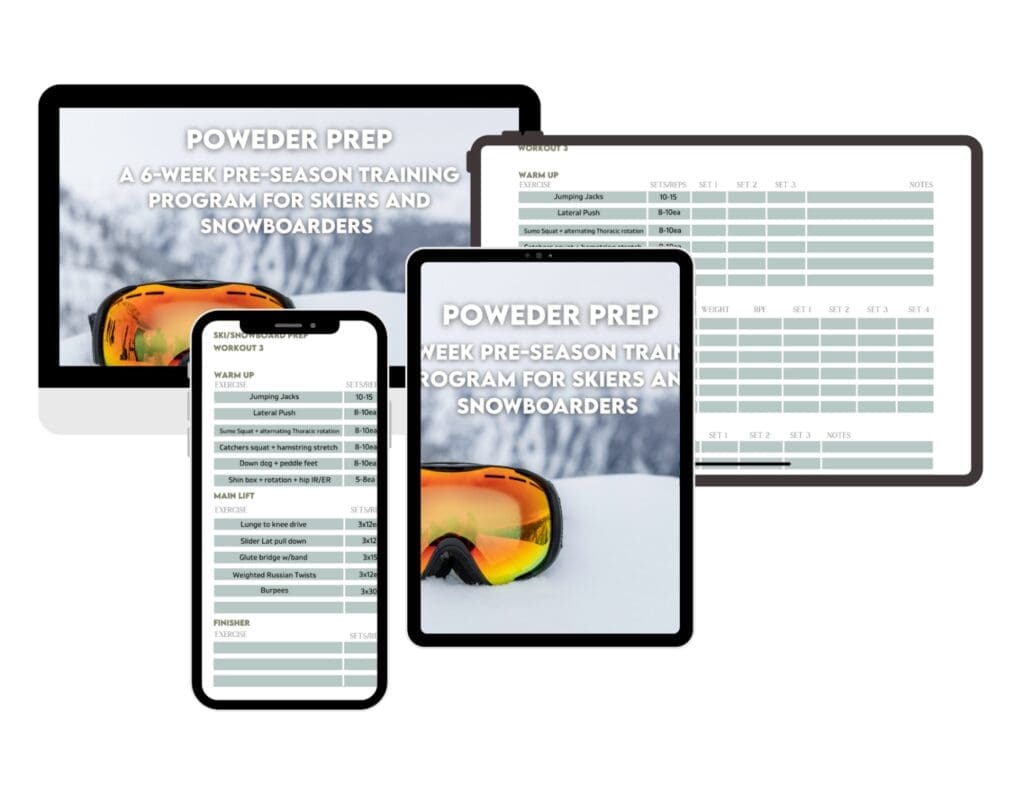
If you’re looking for a full 6 week program that is going to help prepare you for your upcoming season on the mountain. I built and designed Powder Prep which is a 6-week ski and snowboard strength program.
This program was designed by two Doctors of Physical Therapy who are winter sport athletes themselves, to help you feel stronger and more confident on the mountain this season.
Over 6 weeks you’ll build the endurance, strength, balance, stability, and power needed for long days on the mountain, so you can reduce the risk of nagging aches and old injuries resurfacing.

